-small.jpg)
The trail near the trailhead is composed of gravel. That soon changes in about a quarter mile.
To get there head north on I-35 into Georgetown and turn left onto Highway 29 and head west. Turn right onto D.B. Wood Road and head north into
Cedar Breaks Park. Obtain a trail map at the park entrance.
The Hike: One of the longest trails in the Hillcountry area is also one of the most overlooked. The Goodwater Trail snakes around Lake Georgetown and almost
completely encircles it. With several trailheads to choose from this hike provides ample opportunities for short day hikes or even a multi-day circumnavigation.
-small.jpg)
A rainy month prior to my hike meant that the falls at Crockett Gardens were gushing more than usual.
The most common starting point for a hike along Lake Georgetown is at Cedar Breaks Park, at the southeastern corner of the lake. Here the trail starts off on a well maintained
surface of crushed stone, but within a quarter mile turns rocky and rough as it approaches the lake shore. Some of the best views of the lake occur near mile marker 1 on the trail and thereafter.
Along the trail there are numerous signs of the people who used to live in the area before the reservoir was filled in. At about the 2.5 mile mark on the trail lies Crockett Springs, sometimes referred to as Crockett Gardens. A natural spring feeds a small water fall. This little oasis provided water for a vegetable garden, that included the first strawberries grown in Williamson County. The remains of several structures can still be seen here, including a corral and a spring house. A history of the land that is now flooded by or adjacent to Lake Georgetown is available on the US Army
Corps of Engineers web site.
-small.jpg)
Lake Georgetown as seen from a point along the trail. Early enough in the day before the boaters showed up.
The roughest, and perhaps most interesting, segment of the trail occurs roughly between mile markers 5 and 7. Here the trail cuts through rough terrain, sometimes passing through gaps between immense limestone boulders over six feet high. Thick clusters of cactus and Cedar also dot the area, sometimes partially overhanging the trail itself.
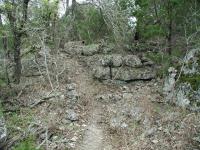
The terrain between mile 5 and 6 may be the most interesting. The trail gets very rough and ventures through numerous rock fields.
Between Mile Marker 7 and the Tejas Camp trailhead (near Mile Marker 11) the trail overall becomes flatter than the preceding miles. But between the long segments that cross lakeside plains there are occasional forays uphill into the Cedar and Oaks.
At Tejas Camp the trail crosses onto the northern shore of Lake Georgetown via a small bridge shared with light auto traffic. The crossing here is short because the lake has tapered back into the shape and name of the North Fork of the San Gabriel River. On the north shore the trail heads east.
-small.jpg)
A view of the upper reaches of Lake Georgetown from the trail during a dry spell.
In general, the north shore's trails are the easier ones and this is particularly true of the trails on the northwest sector of the lake. The trail here consists of wide jeep trails and dirt roads on terrain that gently undulates for several miles before things get a bit rougher.
-small.jpg)
The trail as it edges a slope to the left and a plain leading to the lake on the right.
No more than a half mile beyond Tejas Camp the official trail paradoxically leaves the wider path for a single track through Cedar and cactus. I totally missed this fork in the trail on my original pass and caught it only my return back to Tejas Camp from where I started my day hike. There is no sign indicating this and the wider path parallels this one and will rejoin it a bit later. Proof that the official trail is the narrower path is validated by the appearance of mile marker 12.
The trail's gentle terrain changes drastically near mile marker 16 on the approach to Russell Park. It starts to look more like the south shore with rock outcroppings and boulders strewn about. The original end of the trail was at the 16.6 mile point in Russell Park and it's an uphill trek to get to the parking area there. The climb would be all the more challenging if you had tackled the trail in its entirety up to this point.
-small.jpg)
The area around Tejas Camp at mile marker 11 is a popular fishing spot.
Recent trail work by the Austin Ridge Riders and the International Mountain Bike Association has expanded the trail system beyond Russell Park and to practically encircle Lake Georgetown back to Cedar Breaks Park. I failed to find the continuation from the Russell Park trailhead, but I'm assured that it's there. I'll tackle that final segment on a later trip.
-small.jpg)
Looking back from the northshore to the southshore. Note the more rugged terrain on the other side of the lake.
Although popular with scouting groups for camping trips, the Good Water is not heavily used, particularly when venturing far from the established trailheads. What you will encounter on pleasant days is lots of boat traffic on the water. On one trip I even had to put up with a hovering helicopter on a sight-seeing trip.
Alternate trailheads exist at the end of West Lake Parkway (near Mile Marker 5), at Tejas Camp (Mile Marker 11 at the western-most tip of the lake) and at Russell Park (Mile Marker 16.5). Russell Park is closed from October 1 to March 31 every year, though the Corps of Engineers indicates that it's OK to park outside the park during this time, but at your own risk.
Bicycles are allowed on the trail, but only on the north shore of the lake according to official Corps of Engineers trail maps.