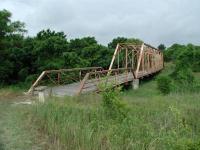
The Hoxie Bridge is one of the old Williamson County bridges salvaged from the scrap yard for the trail.
From I-35 in central Round Rock take the Highway 79 exit
and head east towards Taylor. Once in Taylor turn left onto Highway 95 and head north.
Near the community of Circleville turn right onto FM 1331 and look for the park entrance
on the left in about 4.5 miles.
The Hike: Granger Lake is one of the lesser known recreational areas around Austin. Situated in the rolling terrain of northeast Williamson County on the Blackland Prairie, it offers some interesting sites and good solitude away from the RV camping areas. An added bonus is that there is no charge for park admission for day hikers.
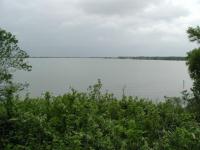
A view of Granger Lake from the trail.
The hike begins at the waypoint "Trailhead" at a parking area that includes a restroom.
Printed trail maps are available here and at a couple of other stops along the trail.
The first section of the trail alternates between wooden sections and small pocket prairies. The trail skirts around a bluff on which RV camping takes place. In the first mile of the hike, the campers can occasionally be seen and are usually heard along the trail. One of the better views of Granger Lake can be found along this first section of trail, however.
-small.jpg)
The trail consists of a mix of wooded segments and open prairie.
The highlights of the first mile are the bridges. Granger Lake and the parks around it
are administered by the U.S. Army Corps of Engineers. So one would expect them to know
how to build a good bridge. Rather than settle on a small wooden span across two creeks
they chose to over-engineer and save a little bit of history at the same time.
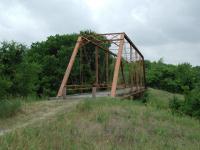
The Friendship Bridge.
The Hoxie Bridge can be found perhaps a quarter mile from the trailhead. It originally
spanned the San Gabriel River, but was washed downstream in a flood in 1921. It was
reconstructed and remained in use until 1979. Rather than send the outdated bridge to
the scrap yard it was moved to Granger Lake in 1982.
The Friendship Bridge can be found at the waypoint of the same name about 1 mile into
the hike. Like the Hoxie Bridge this one was destroyed by a flood in 1921, likely the
same flood as the one that destroyed the Hoxie Bridge, and reconstructed. It too was moved to Granger Lake by the Corps of Engineers in 1982. These two bridges make for fine, if not overbearing, crossing of two of the trail's streams.
-small.jpg)
A few portions of the trail are a little challenging. Here I had to crouch to get under the brush in a creek bed.
The relatively flat, rolling terrain of the area surrounding Granger Lake is somewhat
misleading. The lake's south shore hugs a modest ridge by hillcountry standards, but
it provides a bit more of a challenge than the drive in would indicate. This becomes
particularly evident as the trail proceeds west from an alternative trailhead at the
waypoint "Alt TH". Not only does the vegetation close in on the trail, but the going gets tougher as the path descends into small, but steep, creek beds. On a few occasions I was not entirely certain if I was still on the approved trail and not some maverick trail.
-small.jpg)
Not all of the bridges on the trail are historic or overkill.
Following the ups and downs of the creek crossings, the trail flattens out a bit, but a new obstacle presents itself in the form of cow patties, and lots of them. It's like tip-toeing through a minefield, though without the danger. Still, by all means, watch your step.
Just when the worst seemed over, a more daunting challenge emerges. High water at some time in the past deposited a large amount of driftwood near the lake shore, smack dab in the middle of trail. When I say a large amount, I don't mean a few hundred limbs scattered about, perhaps in a contour line marking the old water line. No, I mean thousands of branches and trunks that litter the ground like poorly constructed wooden planking. There is no stepping around them, there is only walking on them, and trying very hard not to twist an ankle in the process. One might think about turning back, but that would be a mistake.
-small.jpg)
This carpet of driftwood provides an obstacle along the trail.
Things change dramatically at the waypoint "Gate". A fence has kept the cows out and so
the cow patties almost disappear. A gentle glen of trees marks one of the quietest spots
I found along the hike. A short distance to the west the tree cover recedes and some
open prairie leads to a small inlet of the lake marked by the waypoint "Lagoon". Where
I found two boys fishing who seemed to think it odd that I had walked about 3 miles at that
point, with more to follow.
-small.jpg)
After the trials and tribulations, a serene segment in a glade.
The trail west of the lagoon occasionally splits off from the jeep trail into which it
transforms. However, it may be a good idea to stick to the jeep trail, particularly when
poison ivy is out. While the trail was mowed to keep the weeds at bay, the trail surface
showed how prevalent poison ivy is in the part of the trail. Walking on poison ivy stems
is as bad as brushing against them if you happen to touch the soles of your shoe for some
reason.
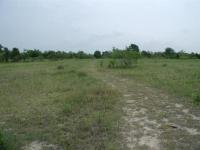
One of the larger pocket prairie segments along the trail.
The end of my hike is marked by the waypoint "Turnaround". However, it may not be the
end of the trail, depending upon your view. The jeep trail continues to south from the
turnaround point, but from this point it appears to be a service road for the primitive
camping area that can be found here. There was not another soul in sight as I stopped in
this well maintained camping area to have a snack and drink of water. The facilities
include tent sites, picnic tables and a chemical toilet.
As I sat on a dead log right along the San Gabriel River just before it feeds into the
lake, I noticed some ants hard at work. Three large ants were busy excavating a depression in the log, making a home for themselves. Two of the ants would pick up bits of wood and crawl to the end of the log and drop the chip off the side. The third ant below picked up chips from the pile and moved them farther away from the log. On and on they went, in tireless toil. Who am I to complain about driftwood and cow patties on the trail?
Doubling back to the trailhead I ended up hiking 7.5 miles, quite a bit more than I was
expecting, but well worth it. On the way back I used the alternate southern loop marked
on the map in blue around the southern edge of the RV camping area. I would generally
not recommend this route since it cuts right through a busy section of the camping area
complete with lots of people, vehicles, boom boxes and the like.